Takrur: The Forgotten Kingdom That Introduced West Africa to the Muslim World
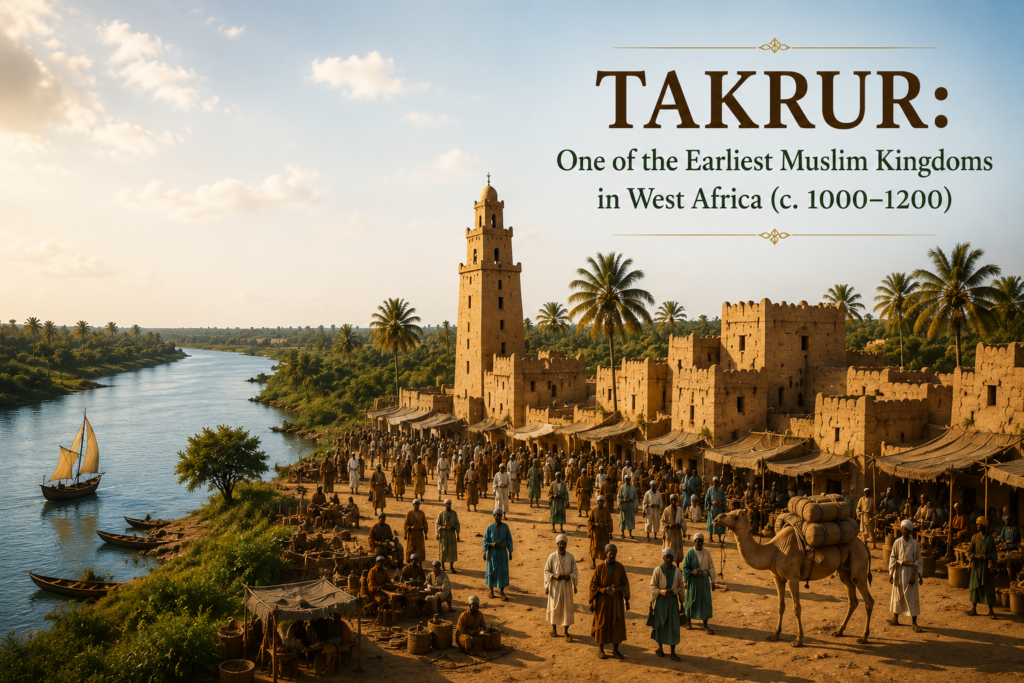
When people think of the great medieval kingdoms of West Africa, names like Ghana, Mali, and Songhay usually come to mind. Yet centuries before the rise of Mali’s legendary emperor Mansa Musa, another kingdom had already established itself as a center of Islam, trade, and political influence. That kingdom was Takrur.
Although it existed for only a relatively brief period as an independent state, Takrur left an extraordinary legacy. Its influence became so widespread that, for hundreds of years, people in Egypt, Arabia, and across the Middle East referred to Muslims from West Africa simply as Takarir, people of Takrur.
This remarkable story is explored by Sudanese historian Dr. Umar al-Naqar in his classic article Takrur: The History of a Name, published in The Journal of African History in 1969. His research shows that the history of Takrur is not merely the history of one kingdom but the story of how West Africans came to be recognized throughout the wider Islamic world.
A Kingdom on the Senegal River
Takrur was located in the lower Senegal River Valley, in what is today northern Senegal and southern Mauritania, a region later known as Fuuta Tooro. Its strategic location placed it at the crossroads of trans-Saharan trade routes linking West Africa with North Africa and the Mediterranean.
Arab geographers first began writing about Takrur during the eleventh century, describing it as a prosperous kingdom inhabited by Black Africans who were becoming increasingly connected to the Islamic world through trade and scholarship. Unlike many neighboring states, Takrur embraced Islam remarkably early, becoming one of the first organized Muslim kingdoms south of the Sahara.
King War Jabi and the Coming of Islam
One of the most important figures in Takrur’s history was War Jabi ibn Rabis (Njaay War Jabi).
According to the renowned Andalusian geographer al-Bakri, the people of Takrur had previously practiced traditional African religions before War Jabi accepted Islam during the early eleventh century. He did not merely convert personally; he established Islamic law throughout his kingdom and encouraged his people to embrace the new faith.
Al-Bakri records that War Jabi died around 1040–1041 CE, and by that time Takrur had become a firmly Muslim kingdom. This development predated the rise of many other Muslim states in West Africa and demonstrates that Islam reached the region through a combination of trade, diplomacy, scholarship, and local leadership—not simply through conquest.
The First Muslim State in West Africa?
Dr. Umar al-Naqar argues that Takrur deserves recognition as the earliest established Muslim state in West Africa.
This conclusion challenges the common assumption that Islam spread into the region primarily through the Almoravids, the powerful North African reform movement. Instead, Umar al-Naqar points out that Takrur had already become Muslim before the Almoravids launched their major campaigns.
Islam had therefore taken root in the Senegal River Valley through earlier contacts, commercial exchange, and local rulers who recognized both the spiritual and political value of joining the wider Muslim community.
A Kingdom Connected to the Wider Islamic World
Takrur did not exist in isolation.
Its rulers maintained commercial and political relations with North Africa while expanding their own influence deeper into West Africa. Arab sources suggest that War Jabi’s successors may even have cooperated with the Almoravids during some of their campaigns.
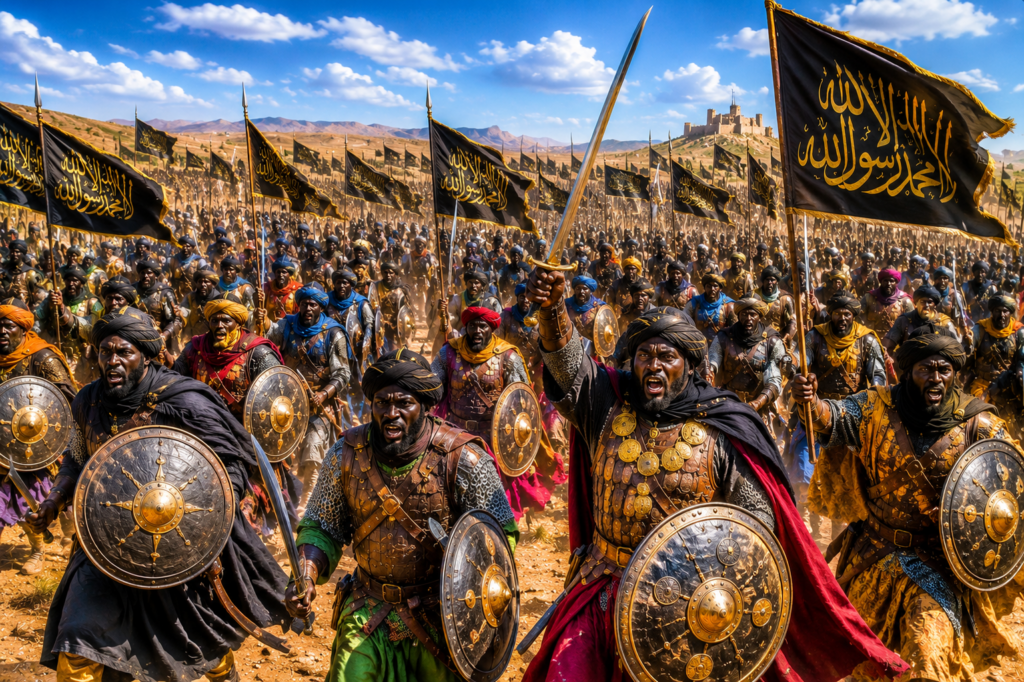
One remarkable tradition cited by Umar al-Naqar reports that approximately 4,000 Black African soldiers fought alongside Yusuf ibn Tashfin during the famous Battle of al-Zallaqah in Spain in 1086. Whether every detail can be verified, the account illustrates how closely connected Takrur had become with the wider Islamic world.
A Prosperous Trading Kingdom
Twelfth-century geographer al-Idrisi paints a vivid picture of Takrur as a thriving commercial center.
He describes a powerful ruler whose authority extended over neighboring towns and whose kingdom was known for justice, security, and prosperity. Merchants arrived from Morocco carrying wool, copper, and glass beads, while returning north with gold, enslaved captives, and other products from West Africa.
These accounts reveal that Takrur occupied a strategic position within the trans-Saharan economy long before the rise of the Mali Empire. The kingdom served as an important gateway linking West African resources with Mediterranean markets.
More Than a City
As Takrur’s reputation grew, the name itself began to evolve.
Initially, Takrur referred simply to the kingdom and its capital. Later writers, however, began using the term to describe not only the state but also its people. Some medieval authors even referred to the ruler as “the Sultan of Takrur,” while others described surrounding towns as belonging to the Takruri kingdom.
This gradual expansion of the name would eventually have profound consequences. What began as the name of one kingdom would later become an identity recognized across much of the Muslim world.
Why Did Takrur Become So Famous?
This is one of the central questions addressed by Umar al-Naqar.
After all, Ghana, Mali, and Songhay became larger and wealthier empires. Why, then, did Takrur become the name remembered throughout the Middle East?
Earlier historians suggested several explanations. Some believed Takrur earned this distinction because it was the first Black African kingdom to embrace Islam. Others argued that later Fulani migrations spread the name across Africa.
Umar al-Naqar carefully examines these theories but finds them incomplete. While Takrur’s early conversion certainly enhanced its prestige, he argues that its enduring fame cannot be explained by religious history alone. Something much larger was taking place—something involving pilgrims, scholars, merchants, and travelers who carried the name of Takrur far beyond the borders of West Africa.
A Legacy Larger Than the Kingdom
By the thirteenth century, Takrur had been overshadowed politically by larger empires such as Mali. Yet its name refused to disappear. Instead, it became increasingly familiar throughout North Africa, Egypt, the Hijaz, and the broader Islamic world.
Ironically, while the kingdom itself gradually declined, its identity continued to expand. The name “Takrur” would outlive the state by many centuries and eventually become synonymous with Muslims from across West Africa.
That transformation is one of the most fascinating examples of how geography, religion, trade, and migration can reshape history.
In our next article, we will explore how the people of one small kingdom gave their name to millions of West African Muslims—from Senegal to Nigeria and beyond—and why pilgrims to Mecca played a decisive role in that remarkable story.
Sources
Primary Source
Major Medieval Sources Discussed
- Al-Bakri, Kitāb al-Masālik wa al-Mamālik (11th century).
- Al-Idrisi, Description of Africa and Spain (12th century).
- Ibn Sa’id al-Maghribi, Kitāb Basṭ al-Arḍ.
- Yaqut al-Hamawi, Mu’jam al-Buldan.
About Post Author