“Téere ak Téraanga”: A Cultural Space Dedicated to African Languages and Literature
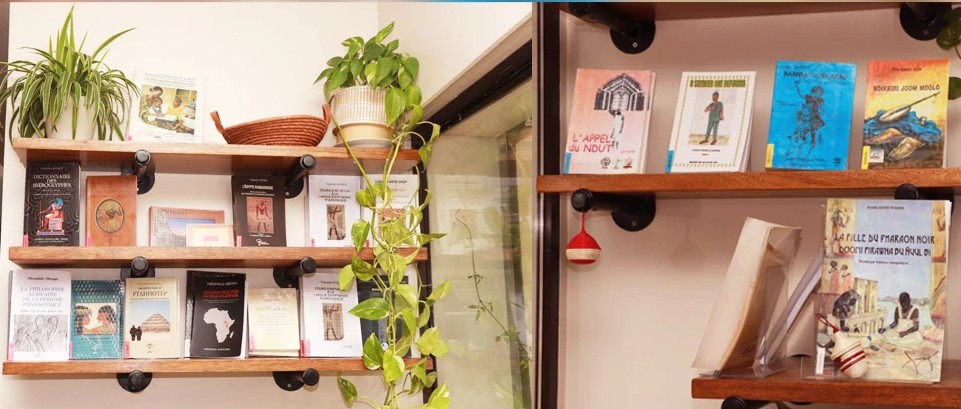
Its name encapsulates its mission: “Téere ak Téraanga” (“Books and Hospitality”), located at the intersection of Boulevard de Saint-Louis and Kaolack Street in the Point E neighborhood of Dakar, is the embodiment of an ambitious initiative to promote Africa’s intangible cultural heritage through books and African languages.
Established under the auspices of the Association culturelle pour la renaissance africaine (ACRA) (African Cultural Renaissance Association), this cultural space, inaugurated in May of last year, seeks to preserve and promote Africa’s intangible heritage by encouraging the transmission of Senegalese and, more broadly, African languages while making written works published in those languages more widely available.
Housed in the lobby of the Imane Residence, the center includes a library containing approximately 200 titles in a variety of African languages, including Wolof, Pulaar, Serer, Bedik, Joola, Malinké, Swahili, and even texts written in Egyptian hieroglyphs.
“Our objective was to promote Africa’s intangible cultural heritage,” explains Fatou Kiné Camara, Secretary-General of the African Cultural Renaissance Association (ACRA), which was officially recognized on March 14, 2025.
The initiative grew out of the observation that Senegal’s national languages—even though they have standardized writing systems—are still not adequately supported or promoted.
“If a language is to be respected and flourish, it must be written and read. Our national languages have already been standardized. There is an entire process of language codification, and around twenty Senegalese national languages have been codified,” said Camara, who is also a professor of law at Cheikh Anta Diop University (UCAD) in Dakar.
For her, the remaining challenge is promotion. This issue is particularly urgent because many Senegalese and African intellectuals have written important works in African languages, yet these publications remain largely unknown. She cites Senegalese writers Cheikh Aliou Ndao and Boubacar Boris Diop, as well as Kenyan novelist and essayist Ngũgĩ wa Thiong’o, among the distinguished authors whose books written in African languages have not received the recognition they deserve despite their international reputations. “It is important that these books become known,” Camara insists.
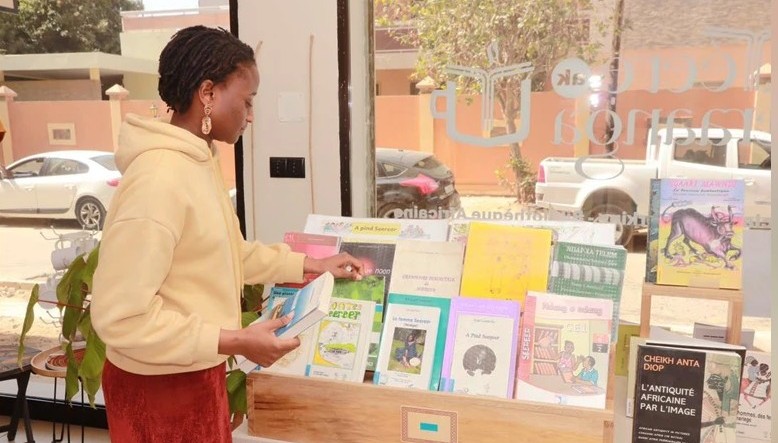
Her own commitment to promoting African languages began early in life through her close relationship with the renowned linguist and pioneer Arame Fall, a longtime family friend.
Camara’s first encounter with books written in Senegalese national languages dates back to the period when Arame Fall was involved in non-formal education through the NGO OSAD (Organization for Support and Development Assistance).
National-language books remain invisible in bookstores
Camara recalls receiving her first books in Wolof from Arame Fall more than thirty years ago. Later, she deepened her knowledge of the language by following literacy and Wolof-language lessons broadcast on Senegalese public television and taught by Emilie Senghor.
“During President Léopold Sédar Senghor’s time, there were literacy and Wolof lessons on television. Emilie Senghor taught them. I watched those programs, and that is how I learned to write Wolof. I often think it’s unfortunate that we no longer have such initiatives today.”
According to Camara, books written in Senegal’s national languages are virtually invisible in both bookstores and libraries.
She notes that they can rarely be found anywhere except at the Fundamental Institute of Black Africa (IFAN), the renowned research institute affiliated with Cheikh Anta Diop University.
“They exist at IFAN, but apart from a few highly specialized bookstores, it is very difficult to find them. That is the problem.”
Yet, she points out, there are already numerous publishing houses producing books in national languages, particularly Pulaar and Wolof.
“We realized that we needed a place where books written in national—and more broadly African—languages could be displayed. That way, Senegalese readers would know these books exist and would begin asking for them.”
Books, hospitality, and intellectual nourishment
The name “Téere ak Téraanga” combines the Wolof words for “book” and “hospitality.” It reflects the center’s mission of encouraging as many people as possible to discover books written in African languages.
“This is a place where we offer free nourishment—both physical food and intellectual nourishment through books,” Camara explains.
Adjacent to the library is a small café offering a welcoming atmosphere where visitors can enjoy millet fritters, fatayas (savory pastries), and locally made fruit juices while reading.
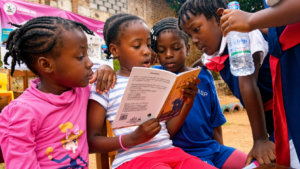
Every Saturday, readers, students, families, and children gather there for reading sessions and storytelling activities.
“It is simultaneously a reading room, a discussion space, and a library. Visitors can browse the books, read them here, and if they wish to purchase them, we tell them where they can find copies.”
Camara hopes the center will help create a lasting momentum for books written in African languages.
A mission for the younger generation
The library is managed by a recent graduate of the Senegalese School of Librarians, Archivists, and Documentation Specialists (EBAD), recommended by the institution itself.
It features numerous children’s storybooks and richly illustrated publications designed to attract young readers.
“What brings me the greatest joy is seeing parents reading these books to their children. Even when a child does not yet speak their mother tongue, the pictures and the sounds immediately capture their attention.”
Camara acknowledges that the center is still relatively unknown.
“We still struggle to make ourselves known. What we truly want is for Senegalese men and women, as well as Africans living here, to embrace this place as their own cultural center.”
A distinctive feature of the space is its introduction to Egyptian hieroglyphs, which Camara describes as “Africa’s mother writing system.”
These courses are made possible through the support of university scholars, including Adjaratou Oumar Sall of IFAN and Mame Thierno Cissé of the Faculty of Letters at Cheikh Anta Diop University, who help recruit instructors for the program.
The instructors themselves also teach free introductory classes in reading and writing Wolof.
Camara also revealed that ACRA launched a program entitled “One Language Each Month” a year ago. The initiative initially offered introductory reading and writing courses in Wolof, Pulaar, and Serer. However, because of insufficient enrollment, the program has been temporarily suspended until greater public interest develops.
“Our languages must become the cause of young people.”
More than anything else, Fatou Kiné Camara hopes that young people will take ownership of the project. Most members of ACRA’s leadership are themselves in their thirties.
“If our languages are to survive, young people must make them their cause.”
She encourages young Africans to embrace their languages—even when they are not taught in school—and to purchase books written in those languages as a way of supporting their development.
“This is a struggle for the youth.”
For Camara, the project is ultimately about more than preserving African languages or protecting Africa’s intangible cultural heritage. Its deeper purpose is transmission—passing knowledge, culture, and identity from one generation to the next.
She concludes by recalling the words of the great Malian scholar Amadou Hampâté Bâ:
“If you do not want something to disappear, pass it on to the children. If you do not want a story or a tradition to be lost, transmit it to the children.”
That philosophy explains why Téere ak Téraanga has devoted such a large portion of its collection to books for young readers and children, ensuring that Africa’s languages, stories, and traditions continue to live on through future generations.
Originally Published in French on March 23, 2026, by APS
About Post Author